
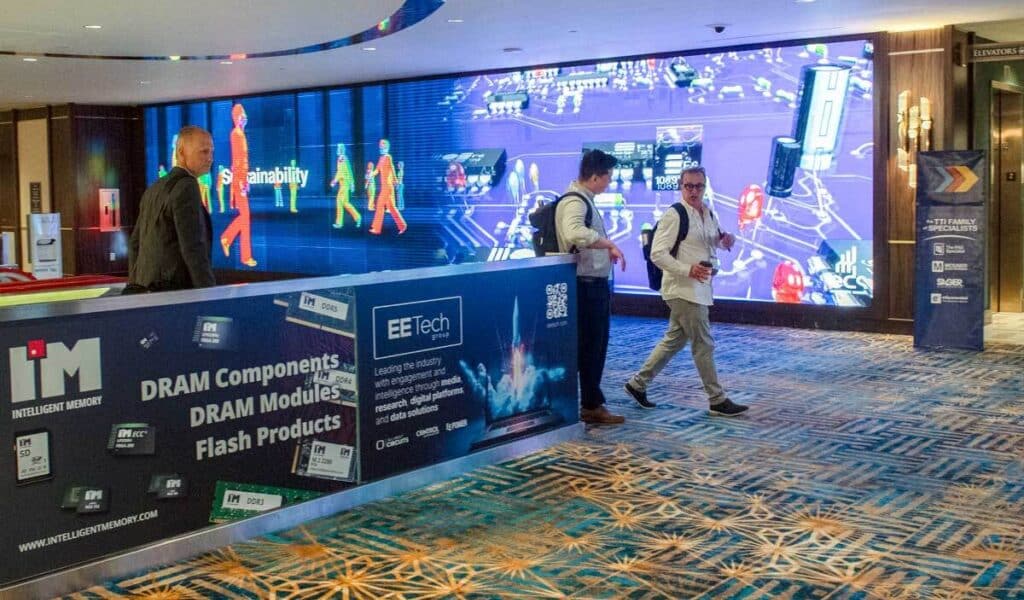
Trade shows are still one of the biggest marketing investments many electronics companies make all year.
They require planning, travel, time, materials, and a lot of internal energy. Teams work hard to get the booth right, schedule meetings, train staff, and make the most of a short window when a large part of the industry is in one place.
Because of that, most companies naturally focus on the most visible measure of success: booth traffic.
How many people stopped by?
How many badges were scanned?
How many conversations happened?
How many names made it into the follow-up list?
Those numbers matter, but they do not tell the full story.
A trade show audience is always bigger than the group of people who stop at a booth. At any event, there are attendees who notice a company without ever starting a conversation. They walk by, see the booth, register the name, hear someone mention the company, or plan to come back later and never do.
That does not mean they were not interested. It simply means their interest was never captured in the most obvious way, and that is where a lot of event strategy gets too narrow.
Booth Traffic is Only the Visible Part
It is easy to build an event strategy around what can be counted quickly.
Booth visits are visible.
Badge scans are easy to report.
Meetings can be logged.
Lead lists can be shared.
That makes booth activity feel like the event itself.
But anyone who has worked a real trade show knows that is only part of what is happening.
Attendees are moving fast. They are juggling meetings, booth visits, hallway conversations, demos, dinners, and travel schedules. Some are actively looking. Some are comparing vendors quietly. Some are gathering information for later. Some are just trying to make the most of limited time.
In that environment, plenty of people will notice a company without stopping long enough to become a lead.
That does not make them unimportant. In some cases, it makes them exactly the kind of audience a company should want to stay in front of after the event.
Why Trade Show Follow-up Often Starts Too Late and Ends Too Soon
For many companies, event follow-up starts with the lead list and ends with an email sequence or sales outreach to the people who were scanned at the booth.
That is a reasonable starting point.
It is also limiting.
When follow-up is built only around the names that were captured directly, it leaves out a broader set of attendees who were part of the same market moment. They were at the show. They were exposed to the same companies. They may have seen your brand. They may have heard your message. They may have intended to engage later.
And once the event ends, those people go back to work just like everyone else. Their inbox fills up. Priorities shift. Memory fades.
That is exactly why post-show visibility matters.
The days and weeks after an event are often when attendees start sorting through what they saw, what they remember, and which companies stayed top of mind. If your company disappears the moment the booth comes down, you lose part of that window.
What “Geofencing” Actually Means
Geofencing is one way to stay visible after an event.
In plain English, geofencing means using location-based targeting around a specific event so a company can serve digital ads to people who were there, even after they have left the show floor.
That matters because it expands the definition of event follow-up.
Instead of focusing only on the people who stopped by the booth, geofencing helps companies stay in front of a larger event audience. That includes attendees who were present, saw the company, or were part of the same buying environment, even if they never had a direct conversation at the booth.
This does not replace booth conversations, meetings, or badge scans.
It adds another layer to the strategy.
The booth creates visibility in person. Geofencing helps extend that visibility after the event, when attendees are back at work and starting to process what they saw.
Why Geofencing Works for Electronics Trade Shows
This matters especially in electronics and other technical industries, where buying decisions are rarely made in a single moment.
An attendee may see a company at a show and not be ready to engage right away. They may be gathering options. They may be attending on behalf of a team. They may need time to compare products, talk internally, or understand how one supplier differs from another.
In other words, the first moment of awareness is often not the moment of action.
That is why it is risky to define trade show success only by who stopped at the booth.
A better approach is to recognize that events create a short period of concentrated attention. For a brief time, the right people are gathered in one place, focused on the same category, thinking about similar problems, and comparing similar companies.
That attention is valuable.
The question is whether a company treats it like a one-time booth interaction or as the start of a wider post-event opportunity.
What a Broader Event Strategy Looks Like
A broader trade show strategy still includes the basics:
- booth presence
- meetings
- lead capture
- follow-up from sales
But it also asks a bigger question:
How can the company stay visible to the people who were at the event, including the ones who did not stop and scan?
That is where geofencing can be useful.
It gives companies a way to remain part of the conversation after the event, not just during it. And in many cases, that is when interest starts becoming more serious.
The event may be over, but the decision process often is not.
The Big Takeaway
Trade shows create more opportunity than booth traffic alone can capture.
The booth matters. The conversations matter. The badge scans matter.
But they are only the visible part of a larger audience.
Companies that understand that can build a smarter follow-up strategy. Instead of treating the event as over once the floor closes, they can keep showing up while attendees are still remembering what they saw and deciding what to do next.
That is the real value of geofencing. It helps extend the life of the event beyond the booth.
If your company wants to stay in front of attendees after the show, Lectrix helps electronics companies do that with geofencing campaigns built for industry events. Reach out to learn more.